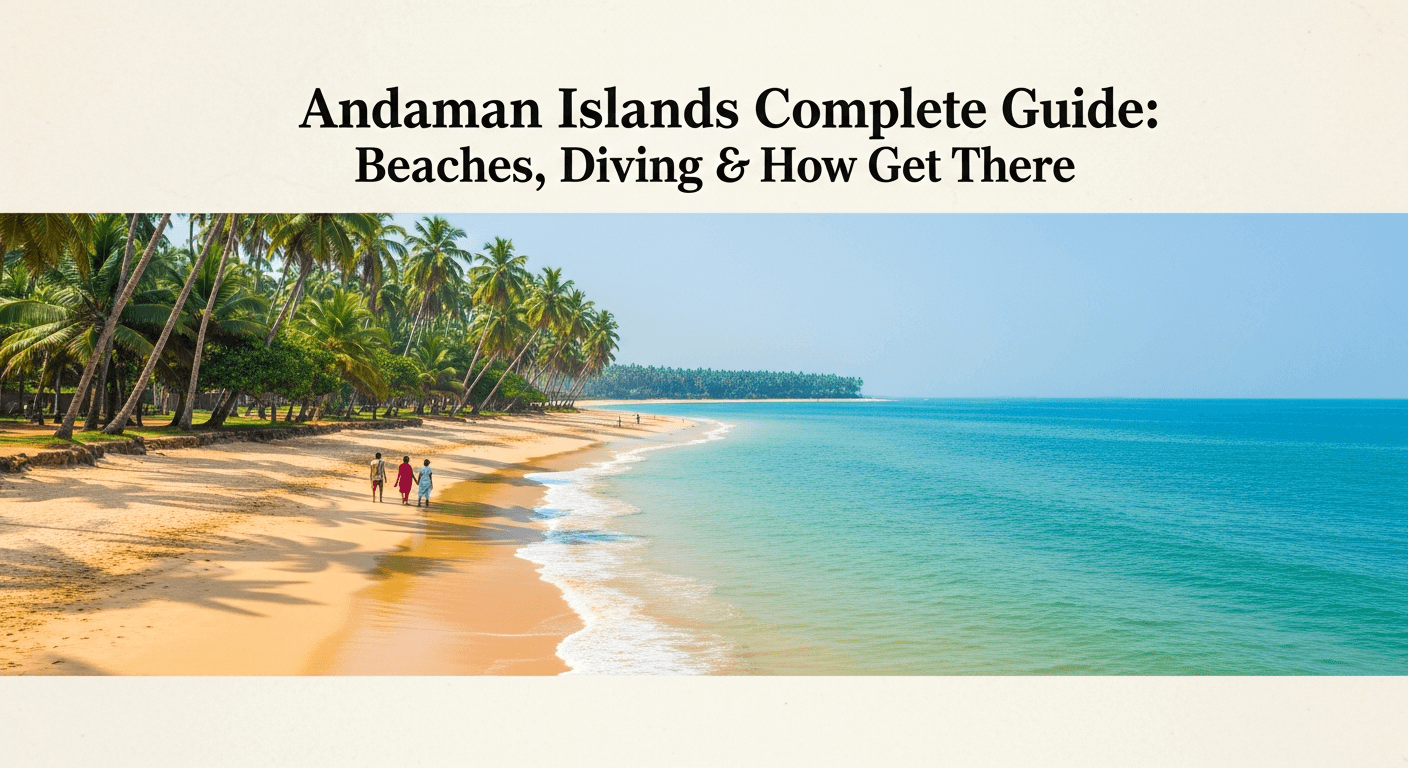
Andaman Islands Complete Guide: Beaches, Diving & How to Get There
Andaman Islands Complete Guide: Beaches, Diving & How to Get There
Imagine turquoise waters so clear you can see coral gardens from the boat, pristine white-sand beaches where your footprints are the only marks, and some of India's most spectacular scuba diving sites waiting beneath the surface. The Andaman Islands are exactly that—a tropical paradise 1,200 kilometers off India's eastern coast that feels worlds away from the mainland's chaos.
When our team spent two weeks exploring these 572 islands, we discovered why they're India's best-kept beach secret. Unlike the crowded shores of Goa, the Andamans offer genuine solitude, world-class diving, and a unique blend of adventure and relaxation. Whether you're a certified diver, a beach lover, or an adventure seeker, this guide covers everything you need to know.
Key Takeaways
| Question | Answer |
|---|---|
| What is the best time to visit? | November to April (dry season with calm seas ideal for diving and water sports) |
| How much does it cost? | Budget: ₹2,000–3,500/day; Mid-range: ₹4,000–8,000/day; Luxury: ₹10,000+/day |
| How do I get there? | Flights from Delhi, Mumbai, or Kolkata to Port Blair (2–4 hours); ferries from Chennai available |
| Is it safe? | Very safe; excellent tourist infrastructure and minimal crime |
| What should I book in advance? | Flights (especially Nov–Dec), dive certifications, permits for restricted islands, accommodation in peak season |
| What's the visa requirement? | Indian citizens need no permit; foreigners get 30-day visa-free entry under AFSPA relaxation |
| What's the water temperature? | 26–29°C year-round; wetsuits recommended for diving |
1. Getting to the Andaman Islands: Transport Options
Reaching the Andaman Islands is easier than most travelers expect, with multiple transport routes depending on your budget and time. Port Blair, the capital and main entry point, is well-connected to major Indian cities.
Flying is the fastest and most popular option. Direct flights operate from Delhi, Mumbai, Bangalore, Kolkata, and Chennai to Port Blair's Veer Savarkar International Airport. Flight time from Delhi is approximately 3.5 hours; from Mumbai, around 2.5 hours. During peak season (November to December), book flights 4–6 weeks in advance, as prices spike and availability drops quickly. Off-season flights (May to September) are significantly cheaper but coincide with monsoon rains and rough seas.
For budget travelers, ferries operate from Chennai and Kolkata, though the journey takes 2–3 days. The Shipping Corporation of India runs these services, and while ferries are considerably cheaper than flights, they're slower and less reliable during monsoon season. In our experience, the flight is worth the extra cost for the time saved and comfort—especially if you're combining the Andamans with other India travel destinations.
Search and compare flights to Delhi, Mumbai, Bengaluru and Goa at the best prices.
Search Flights on Trip.com →Flight Booking Tips
Peak season pricing: Expect flights to cost ₹8,000–15,000 ($95–180 USD) from major metros during November–December. Off-season flights drop to ₹4,000–7,000 ($48–85 USD). Off-peak advantage: Flying in June or September offers empty beaches and 40–50% cheaper flights, though you'll need to check weather forecasts daily for water activities.
Ferry & Ship Options
Slower but scenic: The Shipping Corporation of India operates passenger ferries from Chennai (2.5 days) and Kolkata (3 days). Cabins range from basic dormitories (₹1,500–2,000) to air-conditioned cabins (₹5,000–8,000). Pro tip: Book ferries at least 3 weeks in advance; they fill up quickly and schedules vary seasonally.
2. Best Beaches: A Detailed Comparison
The Andamans have over 200 beaches, but only a handful are easily accessible and truly exceptional. Each beach offers a different experience, and choosing wisely depends on what you're seeking.
Radhanagar Beach on Havelock Island consistently ranks among Asia's best beaches, and for good reason. The 7-kilometer stretch of powder-soft white sand, backed by lush jungle and fronted by crystalline turquoise water, is postcard-perfect. When we visited at sunset, the sky turned shades of orange and pink that seemed almost unreal. The beach has basic shacks serving fresh seafood, and several resorts nearby cater to all budgets. However, it's the most developed and crowded beach in the Andamans—expect 200–500 tourists daily during peak season.
Elephant Beach, also on Havelock, is the gateway to water sports. Jet skis, parasailing, banana boats, and snorkeling trips depart from here daily. The beach itself is smaller and rockier than Radhanagar, but the energy is vibrant and the accessibility to activities unmatched. If you're keen on action rather than solitude, this is your spot.
Kala Pathar Beach on North Andaman is the antidote to crowds. A 45-minute boat ride from Port Blair, this black-sand beach backed by dense forest feels genuinely remote. The water is calm and perfect for swimming, and you'll likely have the beach to yourself. The downside: minimal facilities, no accommodation directly on the beach, and you'll need to arrange transport via tour operators. Our team loved the peaceful vibe here—it's where you go to escape.
Corbyn's Cove is Port Blair's closest beach, just 7 kilometers from the airport. It's perfect if you're arriving late or leaving early, or if you want to combine beach time with exploring Port Blair's attractions. The beach is small, somewhat crowded, and the water quality isn't as pristine as outer islands, but it's convenient and has good restaurants nearby.
Beach Comparison Table
| Beach | Best For | Crowd Level | Facilities | Rating |
|---|---|---|---|---|
| Radhanagar (Havelock) | Photography, sunset, romance | High (peak season) | Excellent—resorts, restaurants, shops | ⭐⭐⭐⭐⭐ |
| Elephant Beach (Havelock) | Water sports, adventure, snorkeling | High | Good—equipment rentals, food shacks | ⭐⭐⭐⭐⭐ |
| Kala Pathar (North Andaman) | Solitude, nature, photography | Very low | Minimal—bring supplies | ⭐⭐⭐⭐ |
| Corbyn's Cove (Port Blair) | Convenience, quick visits | Medium | Good—restaurants, basic shops | ⭐⭐⭐ |
| Laxmanpur Beach (Neil Island) | Budget travelers, calm waters | Low–Medium | Basic—few shops, homestays | ⭐⭐⭐⭐ |
Skip the hassle — book India day trips, cooking classes, and experiences in advance with instant confirmation.
Browse Activities on Klook → Scan me
Hidden Gem: Neil Island
Quieter alternative: Neil Island, 45 minutes by ferry from Port Blair, offers a slower pace than Havelock. Laxmanpur Beach here is perfect for families and budget travelers, with calm, shallow waters ideal for swimming. The island has a village feel, with homestays and small guesthouses rather than resorts. Local experience: Staying on Neil Island lets you interact with locals and experience authentic island life away from tourist infrastructure.
3. Scuba Diving: The Andamans' Greatest Asset
The Andaman Islands are India's premier scuba diving destination, with visibility often exceeding 30 meters and coral reefs teeming with tropical fish, rays, and occasionally reef sharks. The diving season runs from November to May, when seas are calm and visibility is optimal.
Barren Island is the crown jewel for experienced divers. Located 100 kilometers northeast of Port Blair, this active volcanic island offers dramatic underwater topography—steep drop-offs, underwater caves, and pristine coral walls. The dive sites here attract large pelagic fish and are suitable for Advanced Open Water certified divers only. Visibility regularly exceeds 40 meters. Day trips cost ₹8,000–12,000 ($95–145 USD) per person, including boat, guide, and two dives.
Havelock Island is the diving hub, with multiple PADI-certified dive centers offering courses and recreational dives. Elephant Beach and Jolly Buoy Island are popular shallow-water sites perfect for beginners and certification courses. Open Water certification courses cost ₹15,000–20,000 ($180–240 USD) and take 3–4 days. Recreational dives for certified divers cost ₹3,500–5,000 ($42–60 USD) per dive.
When we completed our Advanced Open Water certification here, the instructors were professional and safety-conscious. The coral gardens at Jolly Buoy were teeming with parrotfish, butterflyfish, and the occasional sea turtle. The water temperature (26–28°C) required a 3mm wetsuit, which the dive centers provide.
Did You Know? The Andaman Islands sit on the Indo-Pacific coral triangle, one of the world's most biodiverse marine regions. Over 600 species of coral and 3,000 species of fish inhabit these waters.
Source: Incredible India
Dive Sites by Experience Level
Compare hotels, resorts, and guesthouses across India with free cancellation on most bookings.
Search Hotels on Booking.com → Scan me
Beginner-friendly: Jolly Buoy Island, Elephant Beach, South Button Island—shallow reefs (5–12 meters), calm conditions, excellent for certification courses.
Intermediate: North Button Island, Cinque Island—moderate depth (12–20 meters), more marine life, some current.
Advanced: Barren Island, Sentinel Island—deep dives (20–40 meters), strong currents, pelagic fish, volcanic topography.
Dive Center Recommendations
Established operators: Havelock has several PADI-certified centers with good safety records. Certification costs: Open Water ₹15,000–20,000; Advanced ₹8,000–12,000; Specialty courses (Nitrox, Deep, Navigation) ₹4,000–6,000 each. Book in advance: During peak season, popular dive centers fill up 2–3 weeks ahead.
4. Snorkeling: Accessible Marine Exploration
Not everyone wants to scuba dive, and the good news is that snorkeling in the Andamans is equally rewarding. You'll see 70–80% of the marine life you'd encounter diving, at a fraction of the cost and with zero certification required.
Elephant Beach offers organized snorkeling trips daily, departing at 10 AM and returning by 2 PM. For ₹1,500–2,500 ($18–30 USD), you get boat transport, snorkel gear, and a guide. The reef here starts just 5 meters from shore, and visibility is typically 15–20 meters. We spotted parrotfish, angelfish, clownfish, and a graceful sea turtle during our snorkel.
Jolly Buoy Island is another excellent snorkeling destination, accessible via boat from Havelock (₹2,000–3,000 including transport and guide). The coral here is pristine, and the shallow depth (3–8 meters) makes it perfect for families and nervous swimmers.
Cinque Island offers a full-day snorkeling experience with lunch included (₹3,000–4,500). The island itself is uninhabited and pristine, with multiple snorkel sites around its perimeter. The journey takes 1.5 hours by boat from Port Blair, but the solitude and marine life justify the trip.
Snorkeling Essentials
What to bring: Reef-safe sunscreen (regular sunscreen damages coral), rash guard or wetsuit, underwater camera, seasickness medication if prone. Best time: Early morning (7–9 AM) offers calmest seas and best visibility. Safety note: Always snorkel with a guide or group; strong currents can occur suddenly.
5. Where to Stay: Accommodation for Every Budget
The Andamans have accommodation ranging from basic homestays to luxury resorts, with the majority concentrated on Havelock and Neil Islands.
Budget travelers should base themselves on Neil Island, where homestays and guesthouses cost ₹1,500–2,500 ($18–30 USD) per night. These are family-run, authentic, and offer home-cooked meals. The trade-off is basic amenities—cold water showers, no air-conditioning, shared bathrooms—but the experience is genuine and the savings substantial.
Mid-range travelers have excellent options on Havelock Island, where resorts and guesthouses cost ₹4,000–8,000 ($48–95 USD) per night. These offer private bathrooms, hot water, fan or air-conditioning, and often include breakfast. Many are within walking distance of Radhanagar Beach or Elephant Beach.
Luxury travelers should consider resorts like Taj Exotica or Barefoot at Havelock (₹15,000–30,000+ or $180–360+ USD per night). These offer beachfront villas, infinity pools, spa services, and fine dining. The experience is world-class, though prices reflect the remoteness and exclusivity.
Port Blair has budget hotels (₹2,000–3,500) and mid-range options (₹5,000–10,000) if you prefer staying near the airport or exploring the capital's attractions. However, Port Blair is less scenic than the outer islands.
Compare hotels, resorts, and guesthouses across India with free cancellation on most bookings.
Search Hotels on Booking.com →
Scan me
Accommodation Comparison
| Type | Location | Cost/Night | Best For |
|---|---|---|---|
| Homestay | Neil Island | ₹1,500–2,500 | Budget travelers, authentic experience |
| Guesthouse | Havelock | ₹3,000–5,000 | Budget–mid-range, beach proximity |
| Mid-range Resort | Havelock | ₹5,000–8,000 | Families, couples, comfort seekers |
| Luxury Resort | Havelock | ₹15,000–30,000+ | Honeymooners, luxury travelers |
| Port Blair Hotel | Port Blair | ₹2,500–8,000 | Airport convenience, city exploration |
Booking strategy: During peak season (Nov–Dec), book accommodation 6–8 weeks ahead. Off-season (May–Sep) offers 30–40% discounts and last-minute availability.
6. Activities Beyond Beaches and Diving
While beaches and diving dominate, the Andamans offer diverse activities for different interests.
Trekking and nature walks are excellent on Havelock and North Andaman. The Kala Pathar trek (2 hours) winds through dense forest to a secluded black-sand beach. The Radhanagar Beach trek through jungle is shorter (30 minutes) but scenic. Both are best done early morning to avoid heat and crowds.
Island-hopping tours are popular day trips from Port Blair. Tours typically visit Ross Island (with colonial ruins), North Bay Island (coral reef viewing via glass-bottom boat), and Viper Island (historic jail ruins). These cost ₹2,500–4,000 ($30–48 USD) per person and are good for history buffs and photographers.
Fishing trips can be arranged through resorts and tour operators. Night fishing is particularly popular, where you fish under moonlight and cook your catch for dinner. Costs vary (₹3,000–6,000 per person) depending on boat size and duration.
Kayaking through mangrove forests is a peaceful alternative to motorized activities. Several operators on Havelock offer 2–3 hour kayak tours (₹2,000–3,500) where you paddle through narrow waterways and spot birds, crabs, and occasionally dolphins.
Did You Know? The Andaman Islands are home to the Andamanese people, one of the world's oldest indigenous populations. However, the majority of islands are off-limits to tourists to protect their isolated communities and way of life.
Cultural & Historical Sites
Skip the hassle — book India day trips, cooking classes, and experiences in advance with instant confirmation.
Browse Activities on Klook →
Scan me
Port Blair attractions: Cellular Jail National Memorial (₹250 entry) is a sobering reminder of India's independence struggle. The light-and-sound show (₹100 extra) runs nightly. Anthropological Museum (₹50) displays artifacts from indigenous tribes. Aquarium (₹100) showcases local marine life. These can be visited in a half-day from Port Blair.
7. Best Time to Visit: Seasonal Breakdown
The Andamans have a tropical climate with two distinct seasons, and timing dramatically affects your experience.
November to April is the dry season and peak tourist season. Seas are calm, visibility is excellent (25–40 meters for diving), and weather is sunny with temperatures around 28–30°C. This is the ideal window for diving, snorkeling, and water sports. However, beaches are crowded, prices are 50–100% higher, and accommodation books out weeks in advance. If you're visiting during this period, plan 2–3 months ahead.
May to October is monsoon season, with heavy rainfall, rough seas, and reduced visibility. Many dive centers close, and water sports are limited. However, prices drop dramatically (flights 40–50% cheaper, hotels 30–40% cheaper), beaches are nearly empty, and the landscape is lush and green. If you're a budget traveler comfortable with weather uncertainty, this is your window. In our experience, even during monsoon, you'll get 2–3 sunny days per week suitable for beach activities.
June and September offer the best off-season value—cheaper prices, fewer tourists, and occasional good weather windows. July and August see peak rainfall and are best avoided unless you're specifically seeking solitude and don't mind limited activities.
For diving specifically, November to April is non-negotiable. Monsoon seas make diving dangerous and visibility poor.
Get an India eSIM before you land. No physical SIM needed — activate instantly on your phone.
Get Saily eSIM for India → Scan me
Month-by-Month Guide
November–December: Peak season. Expect crowds, high prices, perfect weather. Book everything in advance.
January–February: Continued peak season. Slightly less crowded than Dec, still excellent weather. Good compromise between crowds and conditions.
March–April: Shoulder season. Fewer tourists, still good weather, prices begin dropping. Excellent value.
May–October: Off-season. Cheap prices, empty beaches, unpredictable weather. Diving centers mostly closed. Best for budget travelers and those seeking solitude.
8. Permits, Visas & Practical Information
The Andamans fall under the Andaman & Nicobar Union Territory, and there are specific entry requirements and restrictions to know.
Indian citizens need no special permit and can travel freely to all accessible islands. Your standard ID (Aadhaar, passport, or voter ID) is sufficient.
Foreign nationals get a 30-day visa-free entry under the Restricted Area Permit (RAP) relaxation, which was extended indefinitely in 2023. However, this applies only to certain nationalities (check the Andaman & Nicobar Tourism website for your country). You'll receive a permit stamp on arrival at Port Blair airport—no advance application needed. Some nationalities still require advance permits; verify before booking.
Restricted islands like Sentinel Island (home to the uncontacted Sentinelese tribe) and Nicobar Islands are completely off-limits to tourists. Attempting to visit these areas is illegal and dangerous.
Permits for specific activities: Diving in certain protected areas and visiting some islands require additional permits, which dive centers and tour operators handle on your behalf.
Travel insurance is highly recommended, especially if diving. Medical facilities on the islands are basic; serious injuries require evacuation to Chennai or mainland India.
Essential Contacts & Resources
Andaman & Nicobar Tourism: andamantourism.gov.in (official information, permits, island updates)
PADI Dive Centers: Verify certification and safety records before booking. Ask for references from recent divers.
Emergency: Police (100), Ambulance (102), Coast Guard (1554)
9. Local Food & Dining
Island life means fresh seafood, and the Andamans deliver some of India's best coastal cuisine. Unlike mainland Indian food, the emphasis here is on simplicity and freshness rather than heavy spices.
Fresh fish curries are the staple—kingfish, barracuda, and snapper prepared in coconut-based gravies. Most beachside shacks will grill your choice of fish with lemon and spices for ₹400–800 ($5–10 USD). When we dined at a simple shack on Elephant Beach, our grilled kingfish was the best we'd had in months.
Crab and lobster are available seasonally and reasonably priced compared to mainland India. A whole crab curry costs ₹600–1,200; lobster ₹1,500–3,000 depending on size and season.
Coconut-based dishes dominate—coconut rice, coconut curries, and coconut chutneys reflect the tropical setting. The coconut here is fresher and more flavorful than you'll find inland.
Vegetarian options are limited compared to mainland India. If you're vegetarian, stick to resorts and established restaurants in Port Blair and Havelock, where they cater to diverse diets. Small island eateries may have limited options.
Alcohol is available at resorts and restaurants but expensive (₹300–500 for beer, ₹800+ for spirits). Bring duty-free alcohol if you plan to drink regularly.
Dining Recommendations
Compare car rental prices across India. Pick up at airports or city locations with flexible cancellation.
Compare Car Rentals →
Scan me
Budget: Beach shacks on Elephant Beach and Radhanagar serve fresh seafood for ₹300–800 per meal. Mid-range: Restaurants in Havelock town (₹600–1,500 per meal) offer better ambiance and variety. Splurge: Resort restaurants (₹1,500–3,000+) offer fine dining with sea views.
10. Safety, Health & Practical Tips
The Andamans are genuinely safe for tourists, with minimal crime and excellent medical facilities in Port Blair. However, island living comes with specific considerations.
Mosquitoes and insects are prevalent, especially during and after monsoon. Dengue and malaria are rare but possible. Use insect repellent (DEET-based), wear long sleeves at dawn and dusk, and consider antimalarial medication if staying longer than 2 weeks. Consult your doctor before traveling.
Sun exposure is intense near the equator. Reef-safe sunscreen (SPF 50+) is essential—regular sunscreen damages coral. Reapply every 2 hours and after swimming. Dehydration happens quickly; drink 3–4 liters of water daily.
Water safety: Tap water in Port Blair and Havelock is generally safe, but stick to bottled water on smaller islands. Avoid ice from unknown sources.
Marine hazards: Sea urchins, stonefish, and sea snakes exist but are rare. Wear reef shoes when wading. Never touch coral or marine life. If stung by a sea urchin, soak the area in hot water (as hot as you can tolerate) for 20–45 minutes.
Medical facilities: Port Blair has a government hospital and private clinics. Havelock has basic clinics; serious issues require evacuation to Port Blair or the mainland. Travel insurance is strongly recommended.
Internet & connectivity: Cellular networks (Jio, Airtel, Vodafone) work well in Port Blair and Havelock but are spotty on remote islands. WiFi is available at most resorts. Consider an eSIM or local SIM card for reliable connectivity.
Pre-Trip Checklist
- Book flights 4–6 weeks in advance (peak season)
- Arrange dive certification or book courses in advance
- Purchase travel insurance covering diving
- Get vaccinations (Hepatitis A, Typhoid) if needed
- Book accommodation 6–8 weeks ahead (peak season)
- Check visa requirements for your nationality
- Arrange permits if visiting restricted islands
- Pack reef-safe sunscreen, rash guard, and insect repellent
Frequently Asked Questions
How many days should I spend in the Andamans?
For a relaxed experience, 5–7 days is ideal. This allows 2–3 days on Havelock (diving/snorkeling/beach), 1–2 days on Neil Island, and 1–2 days exploring Port Blair or day trips. Budget travelers might stretch this to 10 days to maximize value.
Can I visit the Andamans with kids?
Absolutely. Beaches are family-friendly, snorkeling is accessible for children 8+, and activities like island-hopping and kayaking are suitable for families. Avoid scuba diving with young children (minimum age is typically 10–12 depending on certification).
What's the cost of a typical 5-day trip?
Budget: ₹15,000–20,000 ($180–240 USD) including flights, accommodation, food, and activities. Mid-range: ₹30,000–50,000 ($360–600 USD). Luxury: ₹75,000+ ($900+ USD). Flights typically account for 40–50% of total cost.
Is it safe to swim in the sea?
Yes, generally very safe. Avoid swimming at dusk/dawn (when sharks feed), don't venture far from shore alone, and wear reef shoes. Jellyfish are rare but possible during monsoon; ask locals before swimming.
Can I get certified to dive in the Andamans?
Yes. Open Water certification courses take 3–4 days and cost ₹15,000–20,000. Courses are offered by PADI-certified centers on Havelock. You'll do confined-water training in pools, then open-water dives on the reef.
What should I pack?
Reef-safe sunscreen, rash guard/wetsuit, snorkel gear (optional), insect repellent, light cotton clothing, flip-flops, waterproof bag, underwater camera, seasickness medication, and a light rain jacket. Avoid heavy luggage; you'll likely take small ferries between islands.
Are there ATMs and payment options?
Port Blair and Havelock have ATMs and accept cards at most resorts and restaurants. Smaller islands and remote areas are cash-only. Withdraw cash in Port Blair before heading to outer islands.
Conclusion
The Andaman Islands represent India's most accessible tropical paradise—a place where world-class diving, pristine beaches, and genuine solitude coexist. Whether you're a certified diver exploring coral walls at Barren Island, a snorkeler marveling at tropical fish at Jolly Buoy, or a beach lover watching sunsets at Radhanagar, the Andamans deliver unforgettable experiences.
The key to a great trip is timing (November–April for diving and perfect weather; May–September for budget and solitude), booking in advance during peak season, and choosing islands that match your travel style. Havelock offers the best balance of activities and facilities; Neil Island suits budget travelers seeking authenticity; Port Blair works for those combining beach time with cultural exploration.
For more inspiration on island travel in India, explore our guides to Lakshadweep and other tropical destinations. And if you're planning a broader India itinerary, check out our best time to visit India guide to coordinate your Andaman trip with other regions.
Ready to book? Start with flights to Port Blair, secure your accommodation 6–8 weeks ahead during peak season, and don't miss the opportunity to dive or snorkel in one of Asia's most biodiverse marine ecosystems. The Andamans are waiting.
Have you visited the Andaman Islands? Share your experience in the comments below—we'd love to hear your stories.