Jaipur Pink City Guide: Palaces, Forts & Hidden Gems
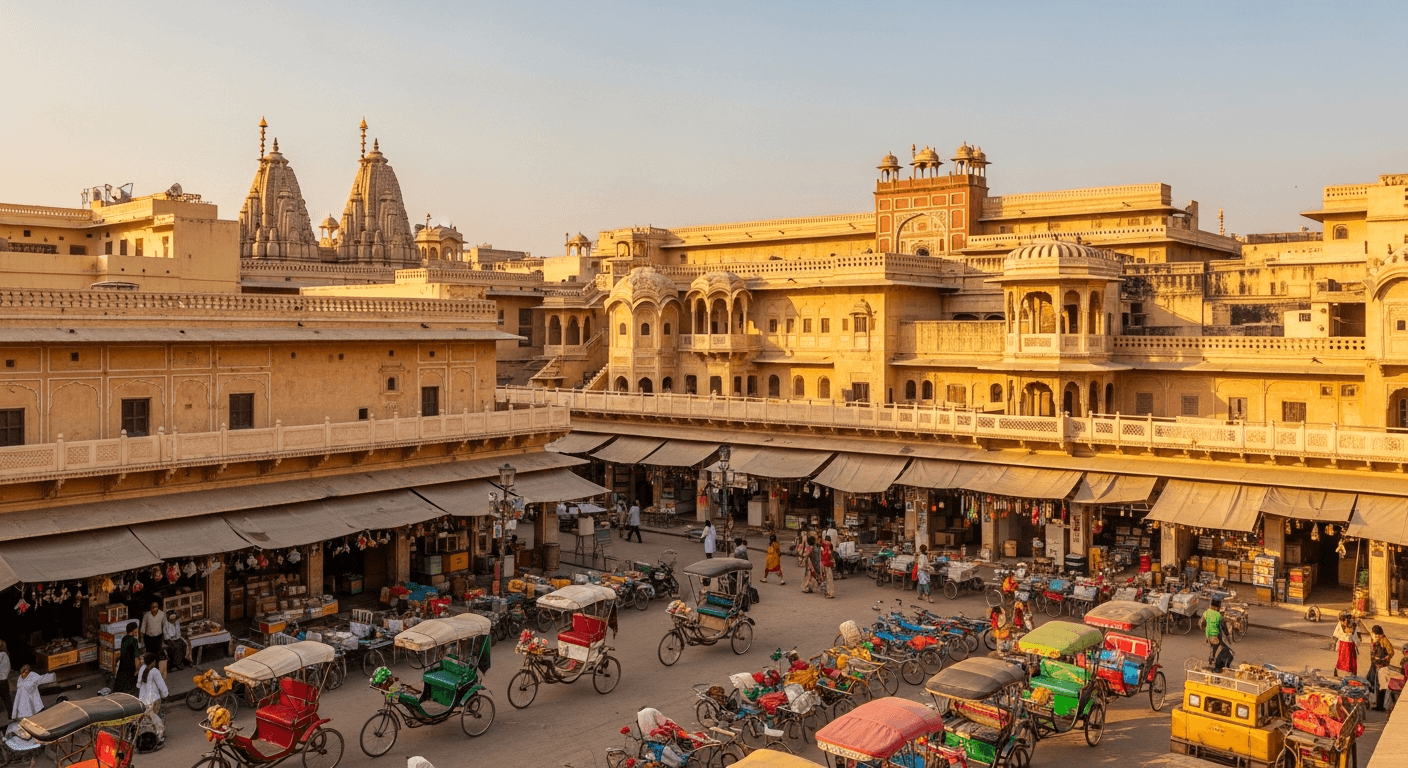
The moment you glimpse the Jaipur Pink City from above—whether arriving by flight or train—you understand why this place has captivated travelers for centuries. The terracotta-rose buildings stretch across the Aravalli foothills like a living watercolor, a testament to one man's vision and Rajasthan's enduring grandeur. Jaipur isn't just another Indian city; it's a carefully planned masterpiece where Mughal symmetry meets Rajasthani swagger, where maharajas once ruled and where you can still taste that imperial legacy in every corner.
Key Takeaways
| Question | Answer |
|---|---|
| What is the best time to visit? | October to March offers perfect weather; avoid May-September monsoon and extreme heat |
| How much does it cost? | Budget travelers: ₹1,500–2,500/day; mid-range: ₹3,000–6,000/day; luxury: ₹10,000+/day |
| How do I get there? | Fly into Jaipur International Airport or take trains from Delhi (4-5 hours) or Agra (4 hours) |
| Is it safe? | Generally safe for tourists; use standard precautions in crowded bazaars and avoid walking alone late at night |
| What should I book in advance? | Palace hotels during peak season (Nov-Feb); major fort tickets can be purchased on arrival |
| What's the local language? | Hindi and English widely spoken; learning a few Hindi phrases goes a long way |
| How many days do I need? | 2-3 days minimum; 4-5 days to experience neighborhoods and day trips |
This article contains affiliate links — if you book through them, we earn a small commission at no extra cost to you, which helps us keep this guide free and up to date.
1. Understanding Jaipur: History & Layout
Jaipur was founded in 1727 by Maharaja Sawai Jai Singh II, who designed the city according to ancient Hindu and Mughal architectural principles. The grid layout—divided into nine blocks representing the nine planets—remains one of the world's finest examples of urban planning. When we first explored the city on foot, that geometric precision became immediately apparent: wide avenues, symmetrical blocks, and the famous pink color (adopted in 1876 to welcome the Prince of Wales) creating an almost dreamlike coherence.
The city sprawls across roughly 115 square kilometers, but the main attractions cluster in the walled Old City and the newer areas to the south and east. Understanding this geography is crucial for planning your time efficiently. The Old City contains the City Palace, Jantar Mantar, and the chaotic bazaars—the heart of Jaipur's soul. Beyond the walls, you'll find modern shopping districts, upscale hotels, and quieter residential neighborhoods.
The Old City (Walled City)
The Old City remains the most atmospheric part of Jaipur, enclosed by walls and gates that once controlled entry. Walking through these narrow lanes—especially early morning before the heat and crowds intensify—feels like stepping into a Rajasthani time capsule. The bazaars here are legendary: Johari Bazaar for jewelry, Bapu Bazaar for textiles, and Nehru Bazaar for spices and everyday goods.
During our time exploring these markets, we discovered that the best approach is to wander without a fixed agenda. Yes, you'll encounter persistent shopkeepers and tourist traps, but you'll also find family-run businesses that have operated from the same spot for generations. The architecture itself—those distinctive pink facades with ornate jharokhas (overhanging windows)—tells stories of Jaipur's merchant class and their prosperity.
South & East Jaipur (Modern City)
The newer areas south of the Old City—particularly C-Scheme, D-Scheme, and around Ajmer Road—contain most of the mid-range and luxury hotels, restaurants, and shopping malls. This is where you'll find contemporary Jaipur: air-conditioned cafes, international cuisine, and the rhythms of modern India. It's less photogenic than the Old City but far more comfortable for extended stays.
The eastern neighborhoods around Vaishali Nagar and Malviya Nagar have emerged as trendy areas with excellent restaurants and boutique accommodations. When we stayed in this area, we appreciated the balance between accessibility and authenticity—close enough to major sights but removed from the tourist crush.
2. City Palace: Where Royalty Still Resides
The City Palace stands as one of India's most remarkable architectural achievements—a seamless fusion of Mughal and Rajasthani design completed in 1734. What makes it extraordinary is that it's not a museum piece: the royal family still occupies portions of the palace, and the current maharaja maintains offices here. This living heritage creates an atmosphere you won't find in purely historical monuments.
The palace complex sprawls across nearly 7 acres, though only certain sections are open to visitors. The Chandra Mahal (the seven-story pink structure that dominates the skyline) remains the royal residence, but the Mubarak Mahal (the cream-colored building to the right) houses a museum displaying royal artifacts, textiles, and weaponry. When we visited, the museum's collection of royal garments and ceremonial objects provided genuine insight into the lifestyle of Rajasthan's elite.
Visiting the City Palace
The palace is best explored with a guide who can explain the architectural symbolism and historical context. Entry costs around ₹1,000 for Indians and ₹1,500 for foreign visitors (prices vary; check current rates). Photography is permitted in most areas, though certain sections remain off-limits to protect the royal family's privacy. The best time to visit is early morning (9-10 AM) when light floods the courtyards and crowds remain manageable.
The palace's layout follows strict Mughal principles: courtyards serve as the heart, with apartments arranged around them for privacy and security. The Pritam Niwas Chowk courtyard features four gates painted in different colors representing different seasons—a detail that reveals the sophistication of the original design. Don't miss the Govind Dev Ji Temple within the palace complex, still an active place of worship where devotional music echoes through the corridors.
Did You Know? The City Palace's construction took seven years and cost Maharaja Jai Singh II 2 million rupees—an astronomical sum in the 18th century. The palace was designed to accommodate the maharaja's entire household, including multiple wives, concubines, and hundreds of servants.
Source: Archaeological Survey of India
3. Jantar Mantar: An Astronomical Marvel
If the City Palace represents Jaipur's architectural ambition, Jantar Mantar embodies its intellectual sophistication. Built by Maharaja Jai Singh II between 1728-1734, this astronomical observation site contains the world's largest stone sundial and remains a UNESCO World Heritage Site. The name itself—"yantra" (instrument) + "mantra" (formula)—perfectly captures its purpose: a collection of 19 geometric instruments designed to measure celestial positions with remarkable accuracy.
What strikes you immediately upon entering is the sheer scale and strangeness of the structures. These aren't decorative—each instrument serves a specific astronomical function. The Samrat Yantra (the massive triangular structure) can measure time to within two seconds of accuracy. The Rama Yantra measures altitude and azimuth of celestial bodies. During our visit, a guide explained how Jai Singh II used these instruments to create accurate astronomical tables, work that influenced scientific thinking across India.
Exploring Jantar Mantar
Entry costs ₹200 for Indians and ₹600 for foreign visitors. Allow 1.5-2 hours for a thorough exploration; hiring a guide (₹300-500) significantly enhances understanding. The site is open daily from 9 AM to 4:30 PM. Photography is permitted, and the stone instruments photograph beautifully in afternoon light when shadows emphasize their geometric precision.
The site can feel overwhelming without context, so we recommend visiting with a knowledgeable guide or downloading an audio guide beforehand. Key instruments to understand include the Samrat Yantra (the primary sundial), the Misra Yantra (combination instrument), and the Jai Prakash Yantra (hemispherical instrument). Each represents different approaches to measuring celestial phenomena—a testament to Jai Singh II's scientific curiosity and resources.
4. Hawa Mahal: Beyond the Instagram Moment
The Hawa Mahal (Palace of Winds) has become Jaipur's most recognizable symbol—that five-story pink honeycomb structure with 953 tiny windows. Built in 1799 by Maharaja Sawai Pratap Singh, it served a specific purpose: allowing royal women to observe street festivals and processions without being seen themselves, respecting the purdah system of the time. Today, it's simultaneously one of India's most photographed monuments and one of its most misunderstood.
The reality is that Hawa Mahal is far less impressive from the inside than from the outside. The interior consists of narrow, cramped corridors and small rooms—hardly the grand palace you'd expect from the exterior. But that's precisely the point: it was never meant to be a palace, just a decorative screen. The real magic lies in understanding its historical context and capturing it from the right angles. The best view comes from the street directly in front, particularly in early morning light when the pink stone glows warmly.
Visiting Hawa Mahal
Entry costs ₹50 for Indians and ₹200 for foreign visitors. The structure is open 9 AM to 5 PM daily. Most visitors spend 20-30 minutes here—time enough to explore the interior and take photos. The real experience comes from positioning yourself on the street in front and observing how the 953 small windows create an almost musical rhythm across the facade.
The surrounding area—particularly Johari Bazaar—offers excellent photo opportunities and authentic bazaar experiences. When we visited, we found that arriving by 8:30 AM allowed us to photograph Hawa Mahal with minimal crowds and softer light. The bazaar behind it comes alive with jewelry shops, textile merchants, and sweet vendors, making this a good area to spend 2-3 hours combining sightseeing with shopping.
5. Albert Hall Museum & Other Cultural Treasures
While the City Palace and Jantar Mantar dominate most itineraries, Jaipur's cultural landscape extends far beyond these two monuments. The Albert Hall Museum, located in Ram Niwas Garden, houses an impressive collection of artifacts spanning art, natural history, and decorative objects. Built in 1887 and named after Prince Albert, it's one of India's oldest museums and reflects the Victorian sensibilities of its era.
The museum's collection includes Egyptian mummies, Indian sculpture, textiles, and an eclectic mix of objects that reveal the collecting habits of Rajasthani royalty. During our visit, we were struck by the museum's somewhat chaotic organization—artifacts from different periods and cultures share space without strict chronological or thematic arrangement—but this very eclecticism offers insight into how 19th-century collectors understood the world.
Other Museums Worth Visiting
Beyond Albert Hall, several smaller museums offer specialized perspectives on Jaipur's history and culture. The Jaipur City Palace Museum (within the City Palace complex) focuses specifically on royal artifacts. The Government Central Museum houses archaeological finds from Rajasthan. The Anokhi Museum of Hand Printing celebrates the traditional block-printing techniques that remain central to Rajasthan's textile industry.
Museum Visiting Tips:
- Best Time: Early morning (9-10 AM) when light is optimal and crowds minimal
- Photography: Generally permitted but check at each venue; some sections may restrict cameras
- Guides: Available at most museums; worth hiring for deeper context
- Combination Tickets: Some museums offer combined entry; ask at the main desk
6. Forts Beyond the City: Day Trips & Excursions
While Jaipur itself contains remarkable monuments, the surrounding region offers several significant forts that deserve day trips. Nahargarh Fort, perched on the Aravalli hills overlooking the city, provides panoramic views and a sense of the defensive strategies employed by Rajasthani rulers. Built in 1734 and originally called Sudarshangarh, it was renamed Nahargarh (abode of tigers) in the 19th century.
The drive up to Nahargarh takes about 30 minutes from the city center. The fort itself is relatively modest compared to Mehrangarh or Kumbhalgarh, but the views compensate entirely. From the ramparts, you can see the entire city spread below, the geometric grid pattern of Jai Singh II's planning visible even from this distance. The fort also houses a small museum and a restaurant, making it suitable for a half-day excursion.
Amber Fort: Jaipur's Crown Jewel
Amber Fort, located 11 km north of Jaipur, represents Rajasthan's military architecture at its finest. Built in 1592 by Maharaja Man Singh I and expanded over subsequent centuries, it's a UNESCO World Heritage Site and arguably Rajasthan's most visited monument. The fort sprawls across a hilltop, combining defensive architecture with palatial elegance in ways that few Indian forts achieve.
The approach to Amber Fort is theatrical: you climb through a series of gates, each more imposing than the last, until you reach the main palace complex. The Diwan-i-Aam (Hall of Public Audience) and Diwan-i-Khas (Hall of Private Audience) showcase the architectural sophistication of Mughal-Rajasthani fusion. The Sheesh Mahal (Mirror Palace) features thousands of small mirrors that create dazzling light effects when illuminated.
Entry costs ₹550 for Indians and ₹1,100 for foreign visitors. The fort is open 8 AM to 6 PM daily. Most visitors spend 2-3 hours here. We recommend hiring a guide (₹500-800) to understand the fort's complex layout and historical significance. Alternatively, elephant rides to the fort entrance are available (₹900-1,100 per person) but consider the ethical implications of elephant tourism before booking.
Did You Know? Amber Fort was the capital of Jaipur state until 1727, when Maharaja Jai Singh II moved the capital to the newly founded city of Jaipur. The fort's strategic location on the Aravalli hills made it ideal for defense but less suitable for the planned city that Jai Singh II envisioned.
Source: Lonely Planet India
7. Bazaars & Shopping: Where to Find Authentic Jaipur
Jaipur's bazaars represent some of India's most vibrant markets, and shopping here is as much about cultural immersion as acquiring goods. The Old City bazaars follow a logical organization: each street specializes in particular goods, a system that has evolved over centuries. Johari Bazaar focuses on jewelry (both precious and costume), Bapu Bazaar on textiles and clothing, and Nehru Bazaar on spices and everyday items.
When we navigated these bazaars, we learned that the key to successful shopping is patience and a willingness to engage with shopkeepers. Bargaining is expected in most shops, though not in fixed-price establishments. Expect to negotiate prices down by 20-40% from initial asking prices. The experience itself—the chaos, the colors, the sounds of merchants calling out—provides authentic insight into how ordinary Jaipur residents shop.
What to Buy & Where
Textiles & Block Printing: Jaipur is renowned for hand-block printed fabrics, a tradition dating back centuries. Shops along Johari Bazaar and Bapu Bazaar offer everything from scarves and sarees to home furnishings. Prices range from ₹200 for a simple scarf to ₹5,000+ for high-quality sarees. The Anokhi Museum's shop (in Ram Niwas Garden) sells premium block-printed goods at fixed prices—higher than bazaar prices but guaranteed authenticity.
Jewelry: Jaipur's jewelry reputation is well-deserved. The city produces both precious jewelry (gold, silver, gemstones) and costume jewelry (lac, beads, artificial stones). Johari Bazaar is the epicenter, with hundreds of shops ranging from tiny family operations to established businesses. Prices vary wildly depending on materials and craftsmanship. For precious jewelry, buy only from established shops with proper certifications.
Handicrafts & Souvenirs: Pottery, wooden items, miniature paintings, and brass goods are widely available. The Government Handicrafts Emporium (on Mirza Ismail Road) offers fixed prices and guaranteed quality, though selection is limited. Bazaar shops offer more variety but require careful quality assessment.
Insider Shopping Tips:
- Timing: Visit bazaars early morning (8-10 AM) for better selection and fewer crowds
- Negotiation: Start at 50% of asking price; settle around 60-70%
- Authenticity: Ask for certificates for precious items; be skeptical of "antique" goods
- Scams to Avoid: Avoid unsolicited recommendations for "family shops"; don't buy gems from street vendors
8. Where to Eat: From Street Food to Fine Dining
Jaipur's food scene reflects its position at the intersection of Mughal and Rajasthani culinary traditions. The city's signature dishes—Laal Maas (a fiery mutton curry), Gatte ki Sabzi (gram flour dumplings in yogurt sauce), and Ker Sangri (a desert vegetable preparation)—showcase the region's distinctive flavors. But Jaipur also offers everything from street food to international cuisine, making it accessible to various palates and budgets.
The street food scene deserves particular attention. Jaipur's chaat vendors, samosa makers, and sweet shops represent some of India's finest street food traditions. When we explored the bazaars, we discovered that the best approach is to eat where locals eat—small stalls with high turnover, indicating fresh food and established reputations. Pyaaz ke Pakode (onion fritters), Mirchi Vada (spicy chili fritters), and Ghevar (a traditional sweet) are must-tries.
Recommended Dining Areas & Restaurants
Old City Bazaars: For authentic street food and traditional restaurants. Lakshmi Mishthan Bhandar (in Johari Bazaar) is famous for its traditional sweets and snacks. Niros (established 1950) serves Rajasthani and North Indian cuisine in a heritage setting.
C-Scheme & D-Scheme: Modern restaurants and cafes catering to tourists and affluent locals. This area offers everything from Indian fine dining to international cuisine. Prices range from ₹300-500 for casual dining to ₹1,000+ for upscale restaurants.
Dining Recommendations by Budget:
- Budget (₹100-300/meal): Street food stalls, small dhabas, local restaurants in bazaars
- Mid-Range (₹300-800/meal): Established restaurants in C-Scheme, heritage hotel restaurants
- Luxury (₹800+/meal): Fine dining restaurants in luxury hotels, rooftop restaurants with city views
Must-Try Dishes:
- Laal Maas: A fiery mutton curry that defines Rajasthani cuisine
- Gatte ki Sabzi: Gram flour dumplings in a yogurt-based sauce
- Dal Baati Churma: Lentils, baked bread, and a sweet crumble—the ultimate comfort food
- Ker Sangri: A traditional preparation of desert vegetables
- Ghevar: A disc-shaped sweet made with ghee and condensed milk
9. Where to Stay: Neighborhoods & Accommodation Guide
Jaipur's accommodation options span from budget hostels to palatial heritage hotels, with choices that suit every traveler type. Your choice of neighborhood significantly affects your experience, so consider what matters most: proximity to major sights, access to dining and nightlife, or immersion in local culture.
Old City (Walled City)
Staying in the Old City places you at the heart of Jaipur's cultural and commercial life. You'll wake to the sounds of bazaars coming alive, have immediate access to monuments, and experience authentic Jaipur. The trade-off is noise, congestion, and limited modern amenities. Accommodation here ranges from budget guesthouses (₹500-1,500/night) to mid-range heritage hotels (₹2,000-4,000/night). During our stays in this area, we appreciated the authenticity but found that noise and traffic made early mornings challenging.
C-Scheme & D-Scheme (Modern City)
These planned neighborhoods south of the Old City offer the best balance for most travelers. You're removed from the bazaar chaos but still within 15-20 minutes of major sights. The area has excellent restaurants, cafes, and shopping. Accommodation ranges from mid-range hotels (₹2,500-5,000/night) to luxury properties (₹8,000-15,000+/night). This is where we'd recommend most travelers base themselves.
Heritage Hotels & Palace Stays
Jaipur's heritage hotels—former palaces and royal residences converted into luxury accommodations—offer unforgettable experiences. These properties range from ₹5,000 to ₹30,000+ per night depending on the property and season. Staying in a heritage hotel provides insight into royal life and creates memories that standard hotels cannot match. Many include cultural programs, traditional meals, and personalized service.
Accommodation Comparison:
| Type | Best For | Price Range | Experience |
|---|---|---|---|
| Budget Guesthouses | Backpackers, budget travelers | ₹500–1,500/night | Basic but authentic; often in Old City |
| Mid-Range Hotels | Most travelers | ₹2,500–5,000/night | Good balance of comfort and value; C-Scheme area |
| Heritage Hotels | Luxury seekers, special occasions | ₹8,000–20,000/night | Immersive royal experience; exceptional service |
| Luxury Resorts | Premium travelers | ₹15,000–30,000+/night | World-class amenities; often outside city center |
10. Practical Information: Getting Around & Essential Tips
Navigating Jaipur requires understanding the city's transportation options and practical realities. The city is sprawling, and while major sights are accessible, getting between them efficiently matters for maximizing your time.
Getting Around Jaipur
Auto-Rickshaws: The most common transport for tourists. Negotiate fares before boarding (typical rides ₹50-150). Insist on the meter or agree on a fixed price. Use Uber or Ola apps for transparent pricing if available. During our time in Jaipur, we found auto-rickshaws convenient but occasionally encountered drivers unfamiliar with less-touristy destinations.
Taxis: Available through hotels or apps; more expensive than autos (₹200-400 for typical rides) but more comfortable and reliable. Hire for full-day sightseeing (₹1,500-2,500 for 8 hours) to visit multiple forts and monuments.
Walking: The Old City is best explored on foot, though narrow lanes and traffic require attention. Major sights like City Palace and Jantar Mantar are within walking distance of each other.
Bicycles & E-Bikes: Increasingly available for rent (₹100-300/day). Good for exploring neighborhoods but challenging in heavy traffic.
Getting to Jaipur
By Air: Jaipur International Airport (JAI) is well-connected to major Indian cities and some international destinations. Flights from Delhi take 1 hour; from Mumbai, 2 hours. The airport is 13 km from the city center; taxis cost ₹500-800, or use airport shuttle services.
By Train: Jaipur Junction is well-connected to Delhi (4-5 hours), Agra (4 hours), and other Rajasthan cities. Trains are reliable and offer good value. Book tickets through Indian Railways website or at the station.
By Road: Buses connect Jaipur to surrounding cities. The journey from Delhi takes 5-6 hours by road.
Best Time to Visit
October to March offers the ideal climate for Jaipur exploration. Temperatures range from 10-25°C, making outdoor sightseeing comfortable. November to February sees peak tourist season with higher prices and larger crowds. April to September brings extreme heat (40°C+) and monsoon rains, making sightseeing challenging.
Money & Costs
ATMs are widely available throughout Jaipur. Credit cards are accepted at hotels, restaurants, and shops in tourist areas, but carry cash for bazaars and small establishments. The rupee fluctuates; check current exchange rates. Budget travelers can manage on ₹1,500-2,500 daily; mid-range travelers should budget ₹3,000-6,000 daily.
Safety & Practical Concerns
Jaipur is generally safe for tourists. Use standard precautions: avoid walking alone late at night, secure valuables, and be cautious in crowded bazaars where pickpocketing occurs. Drink only bottled water; eat at established restaurants to avoid stomach issues. The air quality can be poor during winter months (November-January); sensitive individuals should consider masks.
Language & Communication
Hindi and English are widely spoken in tourist areas. Learning basic Hindi phrases ("Namaste," "Shukriya" for thank you, "Kitna paisa?" for how much) enhances interactions with locals. Download offline maps; internet connectivity is generally reliable but can be slow in some areas.
11. Suggested Itineraries
1-Day Jaipur Itinerary
Morning (8 AM - 12 PM): Start with Jantar Mantar (arrive by 9 AM to beat crowds). Spend 1.5-2 hours understanding the astronomical instruments with a guide. Entry: ₹600 (foreigners).
Late Morning (12 PM - 1:30 PM): Walk to nearby City Palace. Explore the Mubarak Mahal museum and courtyards. Entry: ₹1,500 (foreigners). Lunch at a nearby restaurant.
Afternoon (2 PM - 5 PM): Visit Hawa Mahal (20 minutes), then explore Johari Bazaar for shopping and street food. Entry: ₹200 (foreigners).
Evening (5 PM - 7 PM): Visit Nahargarh Fort for sunset views over the city. Drive time: 30 minutes from Old City. Entry: ₹200 (foreigners).
Total Cost: ₹2,500-3,500 (excluding meals and shopping)
3-Day Jaipur Itinerary
Day 1: Follow the 1-day itinerary above.
Day 2:
- Morning: Day trip to Amber Fort (11 km north). Arrive by 9 AM. Explore the fort for 2-3 hours. Entry: ₹1,100 (foreigners). Consider hiring a guide (₹500-800).
- Afternoon: Visit Jal Mahal (Water Palace) on the return journey—a quick photo stop. Explore C-Scheme area for shopping and dining.
- Evening: Relax at your hotel or explore a neighborhood bazaar.
Day 3:
- Morning: Visit Albert Hall Museum in Ram Niwas Garden. Entry: ₹200 (foreigners). Explore the garden and surrounding area.
- Late Morning: Visit Govind Dev Ji Temple or explore a neighborhood like Vaishali Nagar.
- Afternoon: Final shopping or revisit favorite spots.
- Evening: Depart or extend your stay.
Total Cost: ₹4,500-6,000 (excluding meals, accommodation, and shopping)
Frequently Asked Questions
What is the best time to visit Jaipur?
October to March offers ideal weather (10-25°C). November to February sees peak tourism with higher prices. Avoid April-September due to extreme heat and monsoons.
How many days should I spend in Jaipur?
Two days minimum covers major sights (City Palace, Jantar Mantar, Hawa Mahal). Three to four days allows exploration of Amber Fort, neighborhoods, and bazaars. Five days permits day trips to surrounding areas like Nahargarh Fort and Jal Mahal.
Is Jaipur expensive?
Jaipur is moderately priced by Indian standards. Budget travelers spend ₹1,500-2,500 daily; mid-range travelers ₹3,000-6,000 daily. Luxury travelers can spend ₹10,000+ daily. Monument entries are relatively inexpensive (₹200-1,500).
Can I visit Jaipur as a day trip from Delhi?
Yes, though it's rushed. Trains from Delhi take 4-5 hours each way, leaving limited time for sightseeing. We recommend at least 2 days in Jaipur to experience it properly. Check our Delhi travel guide for Delhi-based itineraries that include Jaipur.
What should I eat in Jaipur?
Try Laal Maas (spicy mutton curry), Gatte ki Sabzi (gram flour dumplings), Dal Baati Churma (lentils with baked bread), and Ker Sangri (desert vegetables). Street food includes chaat, samosas, and mirchi vadas. Ghevar is the signature sweet.
Is it safe to drink tap water in Jaipur?
No. Drink only bottled or filtered water. Most hotels provide bottled water. Avoid ice unless it's from a reliable source.
Do I need a guide for Jaipur sightseeing?
Guides significantly enhance understanding of monuments, especially Jantar Mantar and Amber Fort. Hire through your hotel or at monument entrances (₹500-1,000 for 2-3 hours). English-speaking guides are readily available.
What's the dress code for visiting temples and palaces?
Dress modestly: cover shoulders and knees. Remove shoes before entering temples. Some palace sections may have additional restrictions; ask at entry points. Avoid wearing leather in temples.
Conclusion
Jaipur Pink City transcends its status as a tourist destination—it's a living monument to urban planning, royal ambition, and cultural continuity. Whether you're marveling at the geometric precision of Jantar Mantar, navigating the sensory overload of Johari Bazaar, or watching sunset from Nahargarh Fort, Jaipur offers experiences that connect you to India's imperial past while engaging with its vibrant present.
The city rewards both structured sightseeing and spontaneous exploration. Follow our itineraries to hit major monuments efficiently, but leave room for wandering, for conversations with shopkeepers, for trying street food from vendors you've never heard of. That's where Jaipur's true magic emerges.
Ready to plan your Jaipur adventure? Start with our comprehensive Rajasthan travel itinerary to understand how Jaipur fits into the broader region, or explore our best time to visit India guide to align your trip with ideal conditions.
Trust us with your Jaipur planning. Our team has spent years exploring this city, from luxury palace hotels to family-run guesthouses, from formal tours to spontaneous bazaar adventures. Every recommendation in this guide comes from genuine experience and ongoing research. We're committed to helping you experience Jaipur authentically, safely, and memorably.
Tags
Sources & References

Go2India Team
Exploring India since 2021 | 25+ states visited | Updated monthly
We are a team of travel writers and India enthusiasts who explore the country year-round. Our guides are based on first-hand experience, local knowledge, and verified official sources.
More about us →